




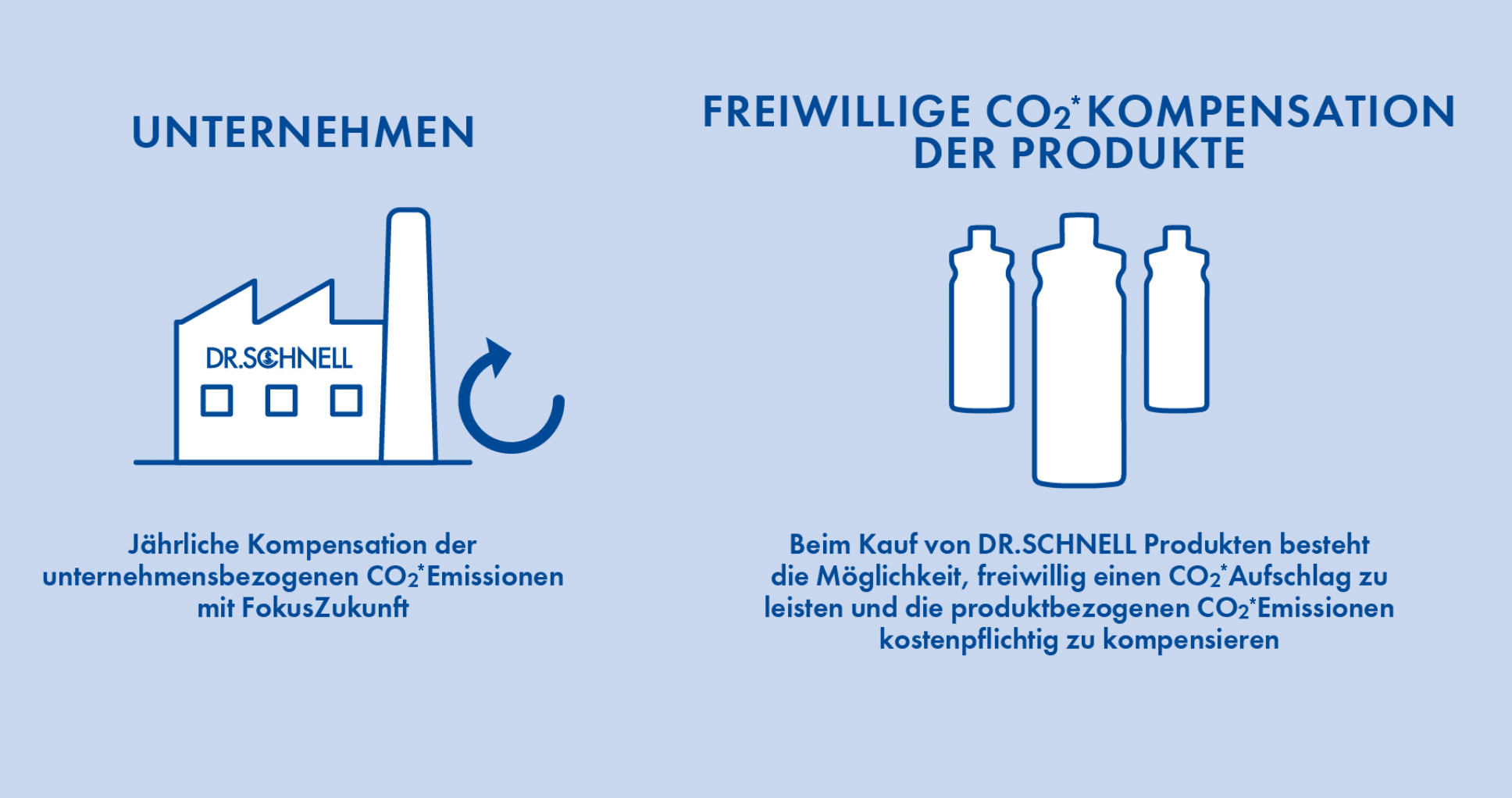
At DR.SCHNELL, we are committed to providing you, our customers, with all the cleaning and disinfecting products you need for your hygiene measures, while minimizing emissions as much as possible. We achieve this through two fundamental approaches: one focused on the company and the other on the products.
In addition to the many measures we describe below, we offset any remaining company-related emissions each year through selected, independently verified climate protection projects. We also enable our customers to offset product-related residual emissions by paying a CO₂ surcharge towards such measures.
Product-related
On a product-specific basis, DR.SCHNELL offers you, our customer, the opportunity to contribute to climate protection yourself through the DR.SCHNELL CO2-Calculator by voluntarily paying a CO2 surcharge when purchasing DR.SCHNELL products. The raw materials we purchase are assessed using the “cradle-to-grave” principle. To this end, we have built a large and constantly growing database of all our raw materials and packaging materials. With this database, we can now assess the environmental impact of each of our products with a single click. Key databases used to calculate product carbon footprints include the EcoInvent database, Version 3.8 (2021), and the GHG Protocol.
We had our approach reviewed by GUTCert’s experts to ensure its scientific accuracy and received certification of compliance with ISO 14067 (Carbon Footprint of Products—Requirements and Guidelines for Quantification).
Company-related
In addition to a wide range of emission reduction measures, DR.SCHNELL GmbH & Co. KGaA offsets its corporate emissions annually through climate protection certificates. To this end, we collaborate with the sustainability consulting firm FokusZukunft, which provides a seal of certification as proof of the annual offset. Further details on the basis of calculation, calculation standards, excluded emissions, emission reduction measures, the type of offsetting, and the specific offset projects are provided further down on this page.
Calculation of Company-Specific Emissions
Our offset measures to compensate for our company-specific emissions are carried out in collaboration with the sustainability consulting firm Fokus Zukunft GmbH & Co. KG. This is a purely company-specific assessment and not a product-specific one. Product-specific emissions were not taken into account.
Comprehensive Climate Protection with DR.SCHNELL
DR.SCHNELL’s offering now gives everyone the opportunity to offset the remaining product-related greenhouse gas emissions from the cleaning and disinfectant products we source.
Our comprehensive package—which includes emissions avoided or reduced through the ongoing implementation of conservation measures, the offsetting of remaining company-related emissions through climate protection projects, and the opportunity we provide our customers to offset the remaining product-related emissions by paying aCO2surcharge in accordance with ISO 14067-certified accounting—comprises our value proposition: DR.SCHNELL Sustainable Hygiene.
Measures to reduce and cut greenhouse gas emissions.
Emissions reduction, as part of a company’s environmental measures, is not a short-term project, but rather the result of sustained, long-term efforts across all areas of the company. Consequently, these measures are not implemented solely to meet certification requirements, but are regularly adjusted as part of the company’s ongoing commitment. We have held EMAS certification since 1998; our environmental and climate protection goals are outlined and updated in our environmental statement. Our climate protection efforts are divided into company-wide and product-specific measures.
An overview of our measures:
Information about the climate protection projects we support.
The emissions calculated as part of the company’s offset measures are offset through climate protection projects certified under the Gold Standard and Verified Carbon Standard. “Gold Standard” and “Verified Carbon Standard” are two quality standards for voluntary offsetting and cover the majority of the market. Both quality standards are listed in the Federal Environment Agency’s brochure among the most important international quality standards (see page 23).

The Gold Standard was developed by the WWF and other environmental organizations. Gold Standard projects also highlight social and environmental aspects that contribute to achieving sustainability goals.

The Verified Carbon Standard (VCS) is the world’s most widely used voluntary standard for offsetting greenhouse gas emissions. In 2015, the VCS accounted for more than half of all transactions in the global voluntary market and is therefore highly relevant to the market, particularly in the area of avoided deforestation. With the addition of CCB (Climate, Community, and Biodiversity Standards), a supplementary standard was created that assesses a project’s overall benefits beyond mere emissions reductions—with a particular focus on biodiversity conservation and social impacts in the project region.
Our Climate Protection Projects
In general, it should be noted that in selecting our climate protection projects, we have not only focused on climate protection aspects and measures, but have also taken into account the principles of holistic sustainability across all three dimensions (ecological, economic, and social). We have placed particular emphasis on the Sustainable Development Goals (SDGs) of the United Nations. Furthermore, we view gender equality and the promotion of quality education as essential components of holistic sustainability, which are reflected in the selected climate protection projects and our social engagement in Germany.
Our offset projects are described in detail and linked below:
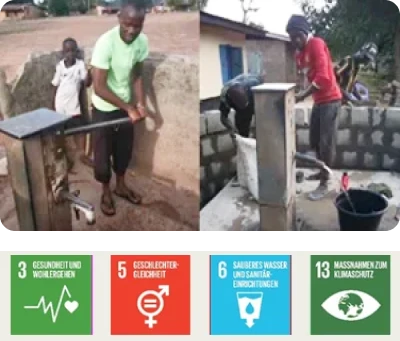
Clean Drinking Water in Sierra Leone
The project supports the provision of clean water through borehole technology for hundreds of households in the Republic of Sierra Leone. Sierra Leone faces major challenges in providing safe water, particularly in rural areas, where over 50% of the population lacks access to a safe water source. Even where improved water sources such as boreholes are available, an estimated 95% of these sources are contaminated with diseases related to poor sanitation, such as E. coli.
As in other parts of sub-Saharan Africa, the lack of access to safe water or other means of water treatment means that rural households are forced to boil water to purify it, which causes significant damage to ecosystems and releases carbon dioxide into the atmosphere. The project operator,CO2 balance, works closely with CODE SL, a local organization in Sierra Leone, to rehabilitate and maintain boreholes and to ensure that good sanitation practices are followed in the communities. By providing clean water, the project ensures that households use less firewood for water treatment, leading to a reduction in carbon dioxide emissions from the combustion process.

Hydropower in Chile
Byoffsetting theCO2 emissions from the products you purchased using the DR.SCHNELLCO2 Calculator(calculated in accordance with ISO 14067) and paying theCO2* surcharge, you are also supporting the following project: the Chacayes Hydroelectric Project in Chile.
This is a run-of-river hydroelectric power plant located in the Cachapoal Valley in Region VI of Chile. The plant has an installed capacity of 110.8 MW and an expected annual net electricity generation of approximately 560 GWh. It uses water from the Cipreses and Cachapoal rivers to generate hydroelectric power for export to the SIC grid. The Chilean government is actively seeking alternative forms of energy to stabilize the energy supply and meet the rapidly growing demand of 350,400 MW per year. However, it is predicted that the system expansion will be driven primarily by thermal energy. This project creates additional capacity for renewable energy and replaces grid power that is partially generated by fossil-fuel-fired power plants. As a result, approximately 357,000 metric tonsof CO2* can be reduced annually.
In addition, this project helps the local and regional population find direct employment, offers continuing education opportunities, and contributes to improving regional infrastructure—for example, by upgrading roads and bridges.

Run-of-river hydroelectric power plant provides electricity in the Indian state of Uttaranchal
The Vishnuprayag Hydroelectric Project (VHEP) is a 4 x 100 MW run-of-river hydroelectric power plant project on the Alaknanda River near Joshimath in the Chamoli district of the Indian state of Uttaranchal. The project is being implemented by Jaiprakash Power Ventures Ltd. (JPVL), a subsidiary of Jaiprakash Associates Limited (JAL). The project generates electricity from renewable hydropower and sells it to the regional power grid operator, UPPCL. The project was commissioned on schedule. It continues to operate successfully to this day, and its expected operational lifespan is 30 years. Since the project activity involves the generation of electricity from renewable energy sources, it reduces anthropogenic greenhouse gas (GHG) emissions that would have been generated if electricity produced from fossil fuels had been fed into the grid. The project’s average annual emission reductions for the crediting period are estimated at 1,468,106tCO2e. This corresponds to an expected total of 44,043,180tCO2efor the entire duration of the crediting period.
The project contributes to the UN Sustainable Development Goals (SDGs) 7 (Affordable and Clean Energy), 8 (Decent Work and Economic Growth), and 13 (Climate Action).
*CO2 values determined using an ISO 14067-certified calculation method